
Systems thinking: architecting marketing ecosystems for audience insights




Most marketing teams don’t have a data problem. They have a structure problem.They have analytics platforms, marketing automation tools, dashboards, warehouses and reports. And yet, the number one question I’m still asked over and over again is essentially: “who’s coming to our website, and what are they doing there?”
So, whither the disconnect? Most marketers just aren’t natural systems thinkers. This isn’t a diss. Marketers tend to think in terms of big ideas, exciting stories and compelling through lines. But we’re typically less naturally predisposed to the more clinical, more deliberate process of really thinking about how to measure the success of what we’re sending out into the world or – to me, even more vitally – how to ensure that the responses to what’s sent out can be used beyond the immediate campaign to enrich the understanding of who’s responding, what they’re responding to and how they’re responding.
On a tactical level, most companies are doing all the right things — email campaigns, programmatic ads, website tracking, gated content — but with different tagging and tracking conventions across each system. So, marketers can often only evaluate performance at the level of the individual channel or tactic – not holistically across cohorts. Yet knowing how well one email performed is vastly different than knowing how well all of these channels operate together for different audiences. The former is tactical; the latter, strategic.
The foundational first step to addressing this is a marketing taxonomy framework — not exhaustive, not perfect, just a consistent habit of asking a few key questions of every tactic. Let’s see how this might apply to a typical use case – say, a local credit union looking to market its products in a variety of ways to different audiences. Here’s what a simple taxonomy might look like:
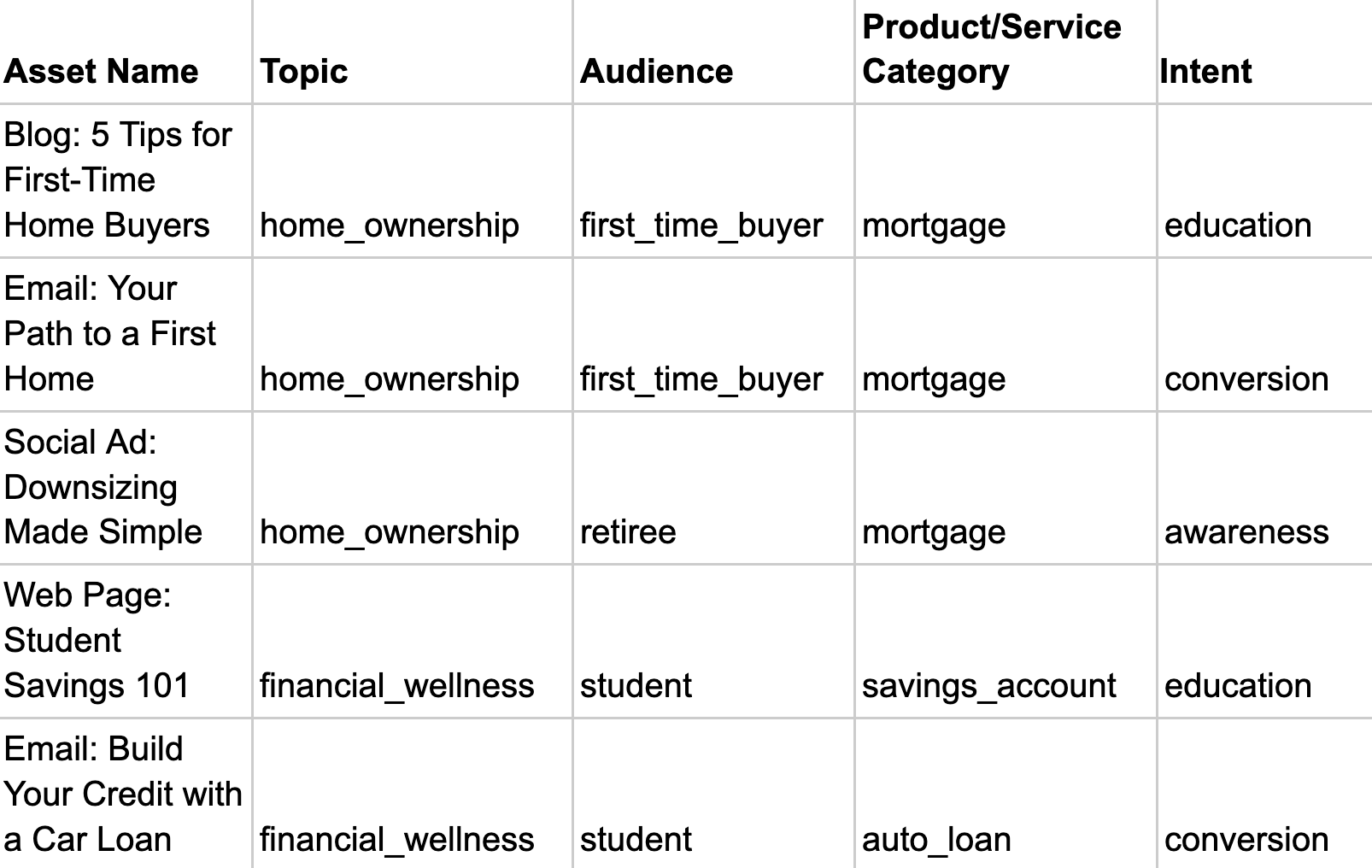 By establishing a simple, consistent taxonomy across tactics early on, we can begin to apply tagging and conventions across the different tools in the stack – e.g., in how emails are tagged within the ESP, how UTM codes are configured in ads and email CTAs, metadata on our blog posts and web pages and so forth.
You’ll notice a few things about the above example that reflect some recommendations I’d have for ensuring a taxonomy provides a clear "signal" instead of noise:
Use snake_case: We want to ensure that the taxonomy is useful for marketers – but also optimally usable by machines – such as for querying within your data warehouse or processing through Claude. Lower-cased snake casing, using underscores instead of spaces, helps maintain the taxonomy in an optimal form for processing, avoids the risk of casing mismatch and maintains a user-friendly, human-readable approach.
Stick to the Singular: Use mortgage instead of "Mortgages." This removes the guesswork for your team and ensures your reporting remains clean and aggregated. Otherwise, you’ll end up with problems with reporting (“mortgage” and "mortgages" are different things by default, as far as your data warehouse is concerned).
Even a simple shared spreadsheet can coalesce a surprising amount of thinking around whom you're marketing to and on what topics. And, as my colleague Jeremy recently noted (Stop Reporting, Start Deciding), the faster you can trust your data, the faster you can take action on it. Where this specific approach really starts to snowball value is when the taxonomy gets referenced and applied across the entire marketing ecosystem. That unlocks:
Consistent terminology everywhere, so you can start comparing and connecting user behaviors and patterns across your tactics and channels
A better understanding of what content and tactics you have for which topics and audiences, and where you may have a deficit
Better efficiencies, since marketers can reference the existing taxonomy to ensure new content is appropriately tagged
A more systematic approach to how individual tactics or campaigns are approached
Companies who do this well start to see the benefit quickly - even informal reviews across marketing channels can rapidly provide a better understanding of, say, how “beginner” vs. “expert”-tagged emails performed in the ESP and how beginner- or expert-tagged resources were engaged with on the website. And, by tagging I don’t merely mean content labels: the same principles apply to event tracking, A/B test naming conventions, audience segments, all of it.
Importantly, none of this really requires any more work. The problem in many organizations is not that data isn’t being captured, or even that data isn’t being tagged – it’s that it’s not being captured, tagged and collected in a consistent way that facilitates insights.
You might be surprised that, as a martech practitioner, I’m not really talking about technology in this blog post. Now, a good martech stack can absolutely help with what I’m describing – from helping with governance to normalizing inconsistent data from across different reporting tools. But (no matter what the sales people might say), these tools aren’t magic, and companies that bring a systems thinking approach to their efforts – ideally across their marketing organization – tend to select the right tools based on their actual data needs rather than their feature envy (and to get far more out of whatever they choose).
In fact, the hardest part of this isn't technical. It's cultural. Getting a marketing team to agree on a taxonomy – and actually stick to it – requires the same discipline as any other systems thinking exercise: a little upfront structure in exchange for a lot of downstream clarity. If your organization is still asking "who's our audience and what are they doing?" every quarter, the answer probably isn't a new tool. It's a shared spreadsheet and a conversation about naming conventions. Start there.
:quality(80))
:quality(80))
:quality(80))
:quality(80))
:quality(80))
:quality(80))
:quality(80))
:quality(80))
:quality(80))
:quality(80))

